

Before we begin: The Settle is this same story, told slower, longer, made for falling asleep to rather than following.
It is built for the nights your head will not stop talking, the same conversation on repeat, long after the room has gone quiet. $6.99 a month, or $59.99 a year.
One subscription. No streaks, no ads, no catch. Press play, and let the day settle.
Prince Freddie found Gilberto sitting perfectly still on the flat rock near the southern tide pools, and knew immediately that something was wrong.
Gilberto was a hermit crab Freddie had met before, on the morning he had found every shell on the beach plugged silent with sea glass. He was not a still creature. A creature of constant small adjustments: his shell, his claws, his sideways gait, his opinions. Freddie had never once seen him motionless.
“Gilberto.”
“Prince Freddie.” He did not move. “I have a problem. It is everyone’s problem. But I have been asked to solve it. So it is currently mine in particular.”
He explained it carefully, in the methodical way of someone who has sat alone with a problem long enough to organise it into sections. Eight crabs. All needing to move into the next size shell as they grew. The system worked on a chain. When a large enough shell arrived on the coast, the biggest crab moved in. Their old shell went to the next one down. This continued all the way to the smallest. Without something new and large entering the system, nobody could move at all.
No new shell had come in for six weeks.
“And the smallest,” Freddie said.
“Her name is Petra.” Gilberto’s claw moved slightly. “She has not been able to retract properly for three days. Her shell is far too small. She is simply too large for it now.”
“Why haven’t you asked for help before now?”
“I have been sitting here since this morning,” Gilberto said, “thinking of shells. I thought of twelve possible sources. I ruled out eleven of them. I have just ruled out the twelfth.” He adjusted his shell. It was considerably too large for him. It had always been too large. He had never once thought to apologise for it. “I am a crab in a shell. It is difficult to be objective about shells.”
“I’ll look,” Freddie said.
He spent the early part of the evening searching. The rocks at the cove end of the beach. The deep tide pools under the headland, where large things sometimes washed in on a high tide. The kelp beds, where shells got tangled and lost. He went as far as the old boat that had rested on the sand for years above the waterline, its wood gone pale and smooth. Nothing large enough. Nothing undamaged.
He was on his way back when he stopped.
The harbour wall. He had passed it that morning. He passed it most mornings. There was a large conch shell wedged into a crack at the base of the harbour steps, near the waterline. Where the stone went dark with damp at high tide. It had been there for as long as Freddie could remember. Sea lavender had grown through it, threading purple flowers out through the opening and up along the wall. He had never once looked at it as a shell. He had looked at it as part of the harbour.
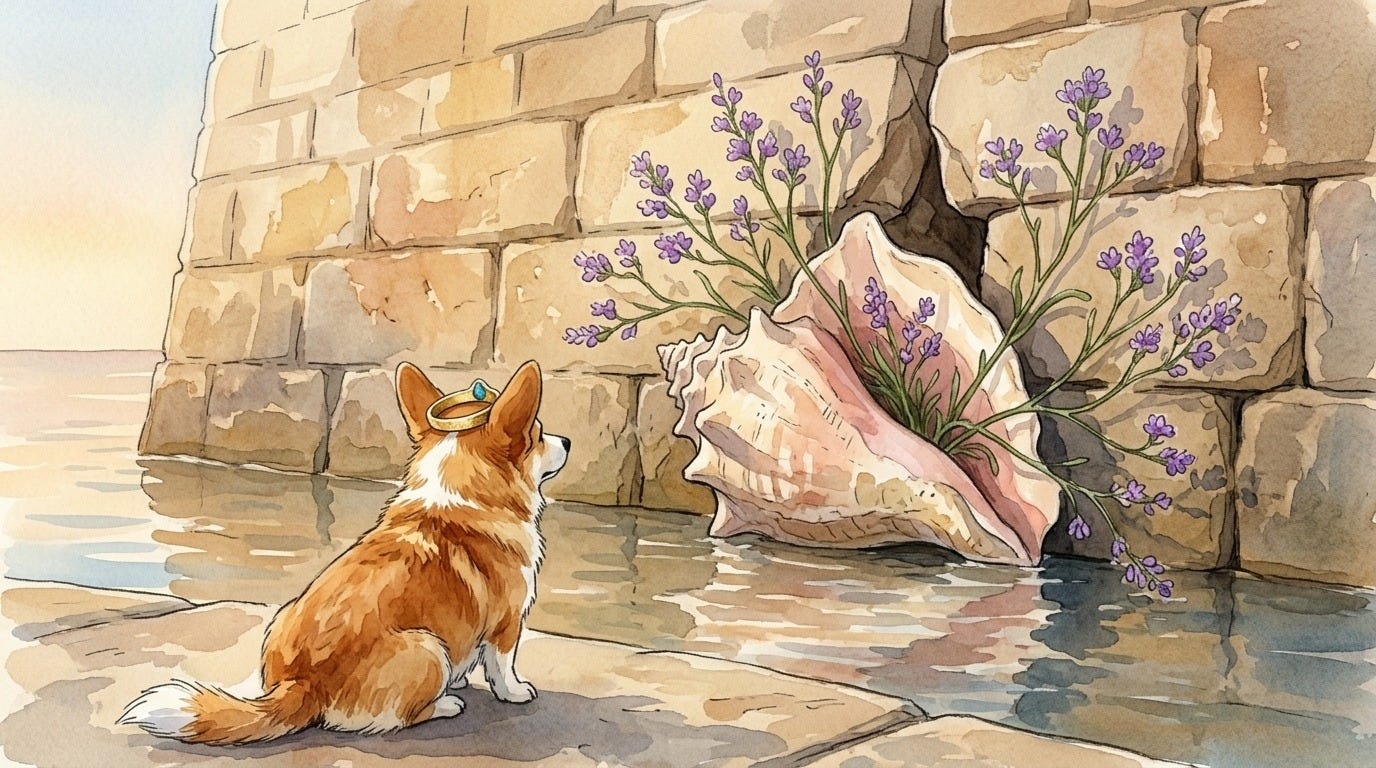
He sat in front of it for a moment. The sea lavender had rooted through the shell. Its stems wove into every corner. The whole thing was fixed to the wall now, fixed as the stone itself. He could see that clearly. This one belonged where it was.
He turned for home.
The cottage was quiet when he arrived, his human not yet back from wherever the afternoon had taken them. The kitchen was still and warm, the light coming in low through the window. Freddie went to the windowsill where they kept the shells.
There were perhaps twenty of them, arranged without system. They collected naturally as a corgi and his human walked the same beach over time, bringing home what caught their eye. A long cone of pale ivory. A disc of something dark and ridged. At the front, lower down, a small spiral. Freddie had nosed it out of the wet sand near the southern rocks one morning. He carried it home without quite knowing why. At the back, a conch. Large and old, its colour faded to warm cream.
Freddie looked at it for a moment. This was their collection, his and his human’s. The beach kept offering things and they both agreed, without discussing it, to accept.
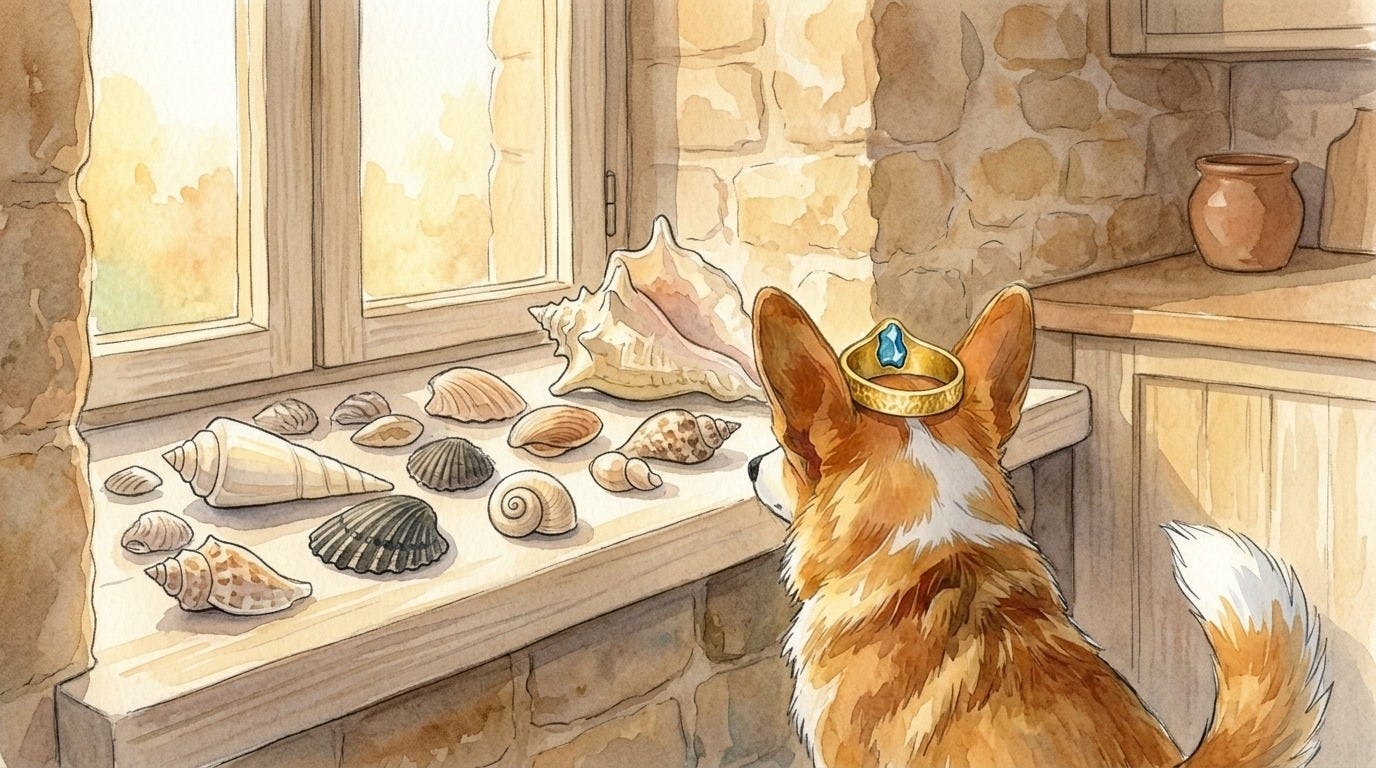
He took it carefully in his mouth and went back down to the shore.
Gilberto looked at the conch for a long time without speaking. Then he said, “Yes. That will do.”
He assembled the chain on the rocks above the tideline as the moon came up. The conch went to the largest crab. She tested it, drew herself into it, emerged. She left her old shell on the rock. The next crab moved into it. And the next. Freddie watched.
When it reached Gilberto’s shell, the crab who needed it was considerably larger than Gilberto. She was, Freddie realised, exactly the size for which Gilberto’s shell had always been designed. His old shell sat on the rock.
“That shell,” Freddie said gently, “is the right size.”
Gilberto looked at his shell. He looked at it for quite a long time.
“I have always been aware it ran slightly large for me,” he said. “I considered it a feature.”
He moved out of it.
His new shell, the one released from the next crab in the chain, was, if anything, even larger. He tested it. It wobbled as he moved. His head barely cleared the opening. He walked a small circle in it, adjusted his weight, then went around once more.
“Excellent,” said Gilberto.
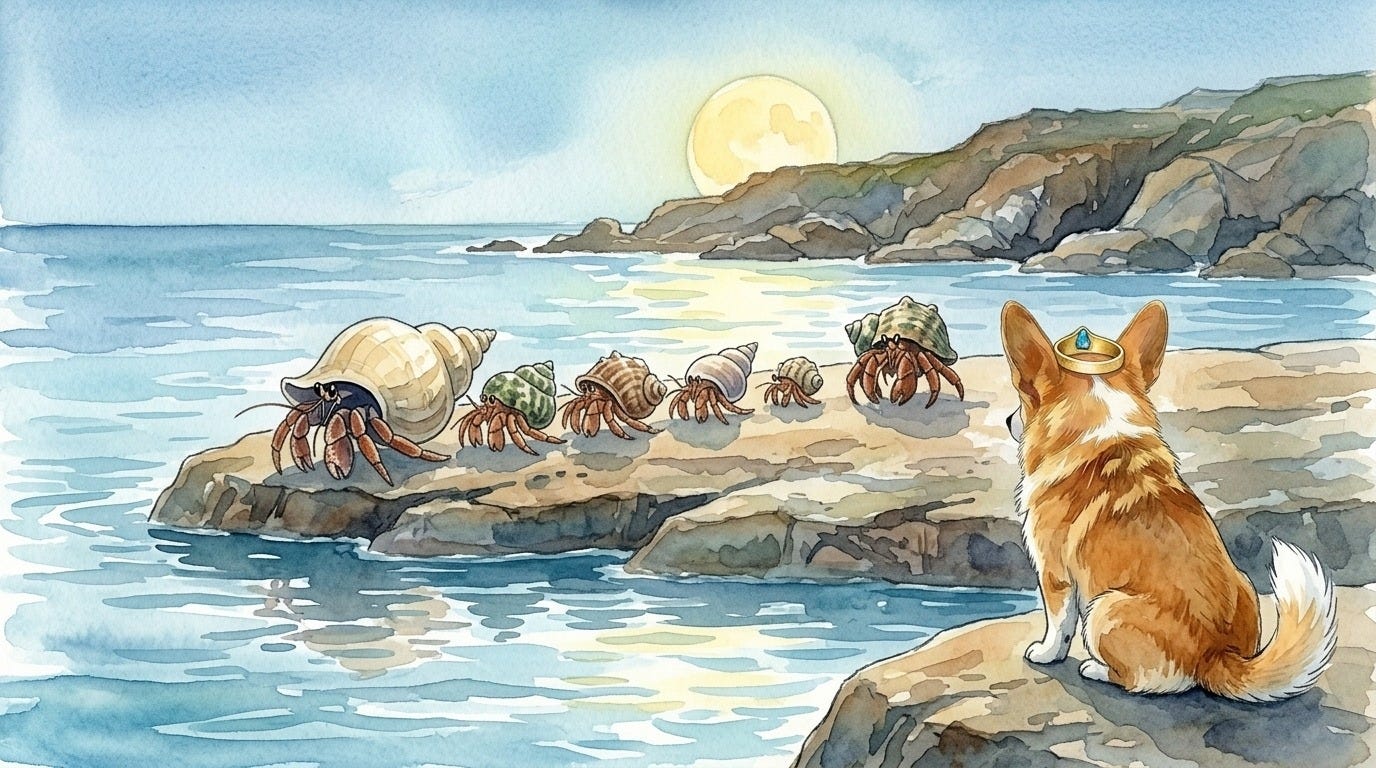
At the end of the chain, Petra moved into her new shell. They all watched. She was very still inside it. She was testing the space. Then she retracted. She pulled all of herself inward. Her legs drew in one by one, until she was entirely gone. The shell sat silent on the rock.
For three days she had not been able to do that.
Gilberto stood in his enormous new shell and looked at the rock where she had disappeared.
“Buenas noches, Petra,” he said softly.
Freddie left them on the rocks as the moon rose over the headland.
He walked back along the harbour path. The shutters of Tiempo Honesto were closed, the shop dark. The square above was quiet. The fountain caught the moon on its water, steady and still.
The cottage was lit when he came up the path. The window held the kitchen warm against the dark. Inside, the air still carried the evening meal, bread and something slow. A small piece waited in his bowl. It had been set aside, the way it always was. He ate it. This was his, and his human knew it.
His human sat at the table. A book lay open, a cup gone cool beside it. They looked up when Freddie came in. Then their eyes went to the windowsill. To the row of shells, and the one space empty now at the back. They looked at the gap. Then they looked at Freddie, and smiled. It was the kind of smile that asks for nothing back. Then they turned back to their book.
After a while Freddie went to the bed. He circled once, twice, three times. On the last circle his body folded sideways against his human’s leg. He was down. The warmth ran the whole length of his side.
His human’s hand came to rest between his shoulders. It moved once, slow, down to the tip of his tail. Then it was still.
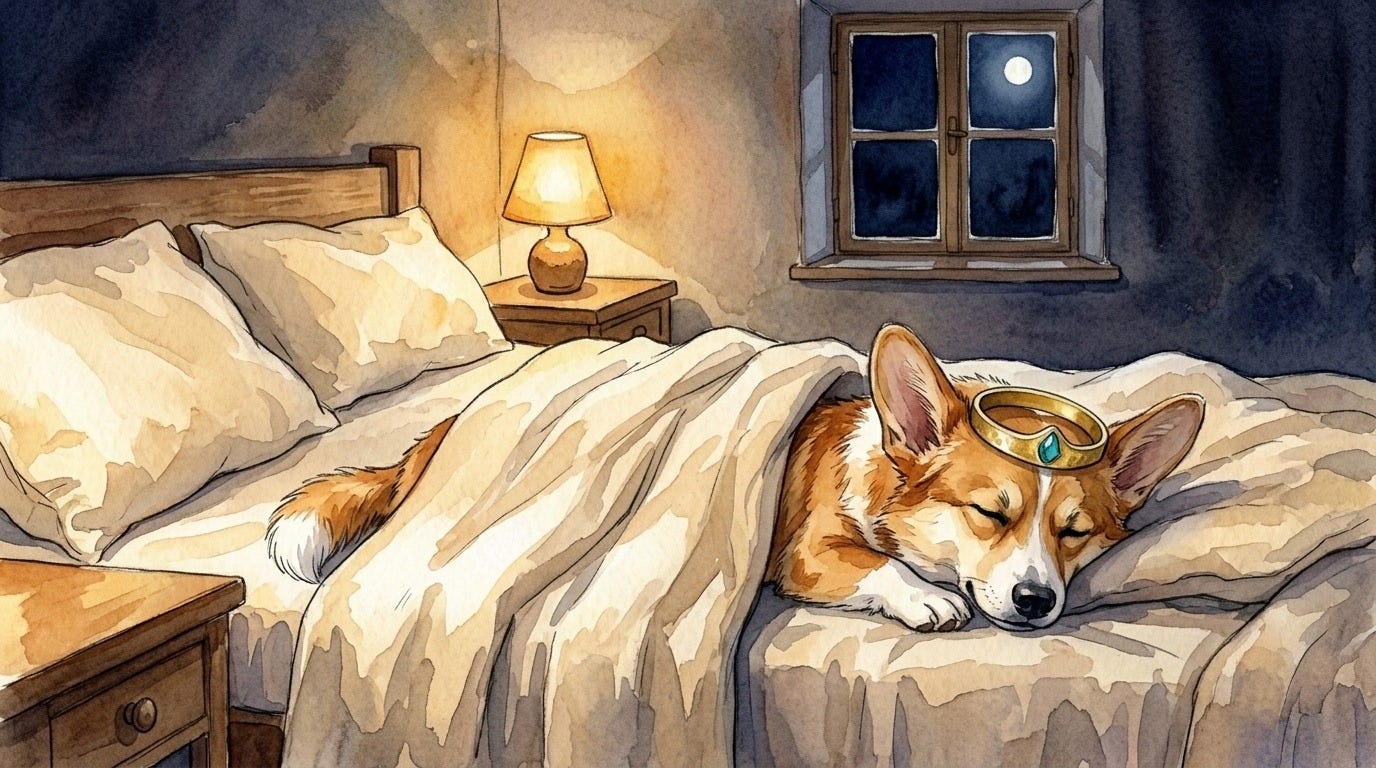
His tail stayed where it had come to rest.
Outside, on the rocks above the tideline, eight hermit crabs were settling. Each had found a shell that fit. Each one was home now, in something the right size at last.
The End
Sleep well, Prince Freddie. Eight crabs settle into new shells on the rocks.
The long, slow telling of this story lives in The Settle, the Companion feed, built to be slept through rather than listened to: https://stories.princefreddie.com/subscribe. This version stays free, always.
The Settle is this same story, told slower, longer, made for falling asleep to rather than following.
One subscription. No streaks, no ads, no catch. Press play, and let the day settle.